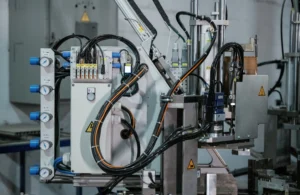
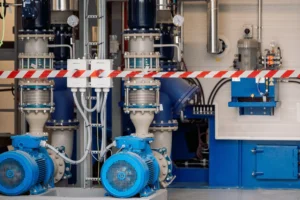
The fundamental difference between pneumatic vs hydraulic is the working medium. Pneumatic systems use compressed air, working pressure is usually 80-100 psi, can achieve fast, clean and low cost action; the hydraulic system uses incompressible oil at a working pressure of 1,000-5,000 psi (special equipment can exceed 10,000 psi) to provide high thrust and precision control. If you pursue speed and cleanliness, you should choose pneumatic; if heavy lifting is required, hydraulic pressure should be proper.
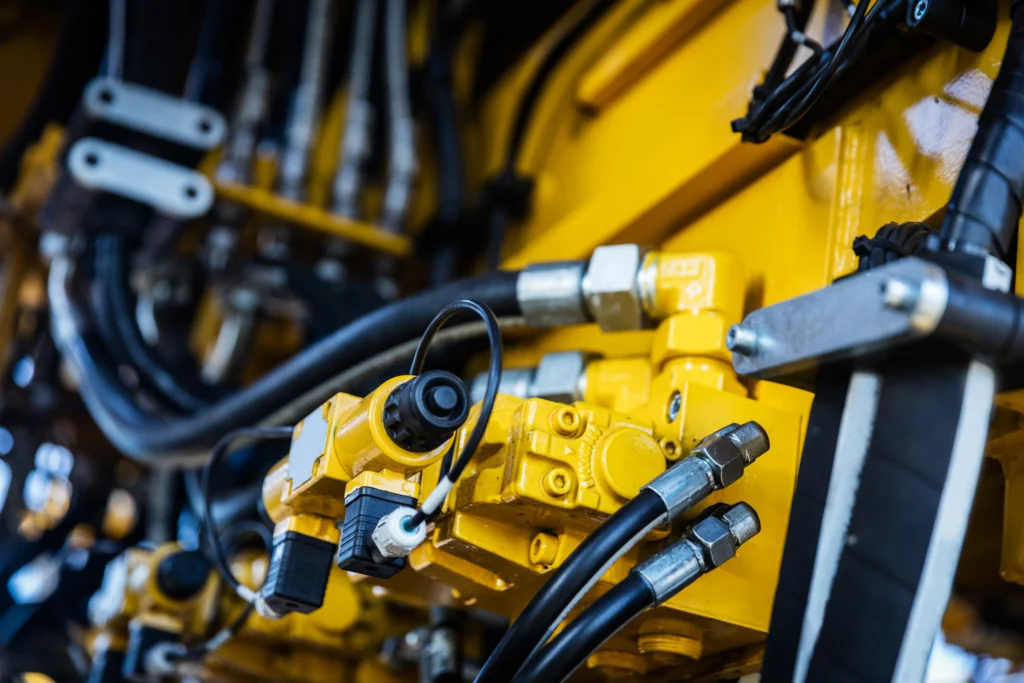
Are you hesitant to choose pneumatic or hydraulic for the next device? Can compressed air really replace the thrust provided by hydraulic oil? Both of them belong to fluid power systems, but when the load increases, the performance is completely different. Misselection will lead to budget overruns and beat delays. Therefore, this article sorts out the real differences, advantages and disadvantages of the two, and gives a fast decision-making method.
How Pneumatic vs Hydraulic Works?
Both of them convert the stored pressure energy into mechanical motion, and the fundamental difference lies in a physical fact: air is compressible, while oil is incompressible. The pneumatic circuit stores the energy in the receiver tank and releases it to the actuator through the valve; the hydraulic circuit is driven by the pump to nearly incompressible liquid, so the pressure can be transmitted almost instantaneously. This behavior is derived from Pascal’s principle, that is, the pressure applied to the closed fluid will be transmitted equivalently in all directions, which is the working basis of each hydraulic press.
In practical applications, it is precisely because of the incompressibility of the oil that the oil can stably support the load, while the air will exhibit the clearance and elastic effects caused by compressibility.
It is helpful to understand the working principle of the actuator itself; please refer to our guide on what a pneumatic cylinder is, which explains how compressed air is converted into linear thrust.
Force & Pressure: Why Hydraulics Can Generate Greater Output Force
Pressure is the primary indicator in the comparison of this force. The operating pressure of most pneumatic equipment is about 80-100 psi, while the common working pressure of hydraulic systems is in the range of 1,000-5,000 psi, and special models can exceed 10,000 psi. Due to the F (force) = P (pressure)×A (piston area), this pressure difference enables the compact hydraulic cylinder under the same cylinder diameter to generate much greater thrust than the pneumatic cylinder.
Therefore, when the task is to suppress, clamp or lift tons of heavy objects, the hydraulic pressure wins by virtue of the original output force; pneumatics is advantageous for its power density and simple structure, rather than large output force.
To match the cylinder bore and pressure against the target load, please refer to our pneumatic cylinder sizing guide, which demonstrates the calculation step by step.
Pneumatic Speed vs Hydraulic Precision & Efficiency
In this regard, the trade-off relationship between the two is the opposite. The air quality is small, and the pneumatic actuator has fast circulation speed, which is suitable for high-speed packaging and assembly. However, the compressibility of air makes it more difficult to accurately locate in the middle of the stroke, so the hydraulic system can maintain the position and speed more stably under variable load conditions.
Energy efficiency is a more hidden cost. Compressed air is often referred to as the “fourth public energy”, but the U.S. Department of Energy pointed out that only 10-20% of the electrical energy input to the compressor reaches the point of use, and the efficiency of the entire system can be as low as 10-15%. In addition, compressed air accounts for about 10% of U.S. industrial electricity consumption. Leakage will further reduce efficiency, so only processed and well-regulated air is economically cost-effective.
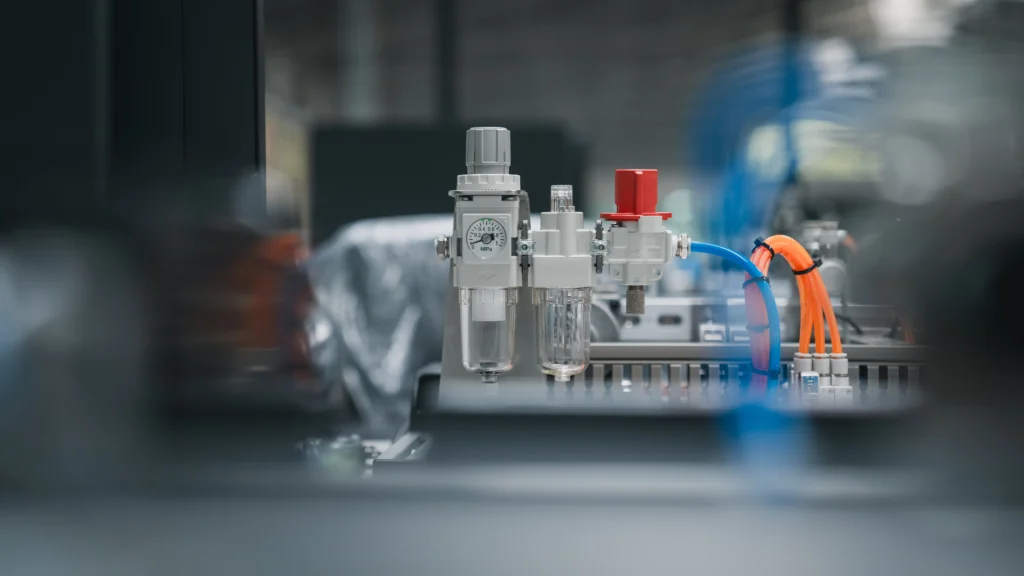
The clean, dry and stable gas source starts from the upstream treatment; please refer to our air preparation units guide to understand the filters, pressure regulators and lubricators that guarantee energy efficiency.
Pneumatic Cleanliness vs Hydraulic Safety & Maintenance
Pneumatic systems are usually cleaner: only filtered air escapes during leakage, so food, pharmaceutical and clean room production lines tend to use pneumatic systems. Hydraulic systems use oil. Leakage can lead to contamination, slip and fire risks, and more liquid maintenance is required.
In addition, there is a clear safety boundary: high-pressure fluid can pierce the skin, and a jet of about 40 bar (≈580 psi) can cause skin damage. High pressure injection injury requires emergency surgical treatment and must be performed within a few hours. Air injection injury can also occur, so both systems require protective measures and personnel training.
Well-sealed assembly can reduce waste and risk at the same time; our guide to choosing pneumatic accessories covers the pneumatic fittings, pneumatic tubing and sealing that keep the circuit sealed.
Pneumatic vs Hydraulic: How to Choose?
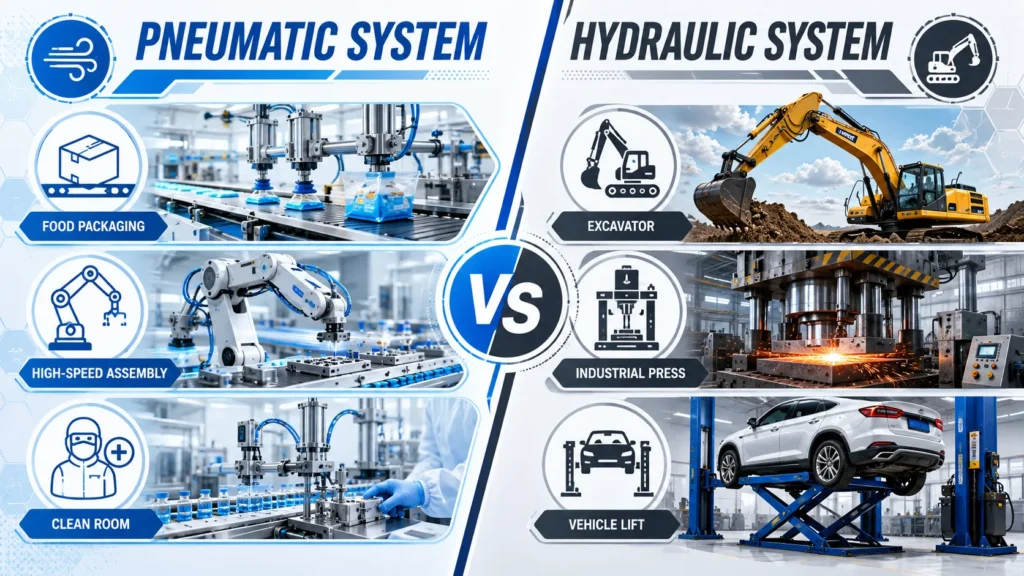
Matching the system according to the dominant demand:
When speed, cleanliness, low initial cost and simple maintenance are the primary requirements, pneumatics should be selected, such as automation, packaging and lightweight clamping;
When continuous high thrust, stable positioning under heavy load or wide temperature range is needed, hydraulics should be selected, such as press, excavator and vehicle lifting.
The four tests of “force, speed, accuracy and environment” can determine most application scenarios. The total cost of ownership and duty cycle are considered in the boundary case.
For most automation and light-to-medium-weight tasks, high-quality pneumatic components are sufficient: select ANRUK pneumatic cylinder and solenoid valve and match the appropriate pneumatic fittings to complete the reliable assembly of the seal.
Which is more powerful, pneumatic or hydraulic?
Hydraulic. Because the oil is nearly incompressible, the working pressure is 1,000-10,000 psi, and the air is about 80-100 psi, the hydraulic cylinder of the same size produces much more force. It is this pressure advantage that makes heavy-duty presses, excavators and industrial lifting almost all use hydraulic systems rather than pneumatic systems.
Is pneumatic cheaper than hydraulic?
Initial installation of a pneumatic system is usually cheaper. Pneumatic components, installation and maintenance costs are lower because components are less pressure-bearing and do not require the use of high-durability materials. However, under the duty cycle of long time and large thrust, the energy consumption of compressed air will push up the total operating cost and offset the initial savings. Therefore, the total cost of ownership should be compared rather than only the price.
How to remove air in a hydraulic system?
Removing air from a hydraulic system-a process called “bleeding”- is crucial for preventing pump cavitation, erratic operation, and internal component damage. You can safely purge trapped air in a few simple steps using the system’s own pressure and components.
What are the main differences between hydraulic and pneumatic systems?
At their core, both hydraulic and pneumatic systems are forms of fluid power . They use a pressurized fluid to transmit energy and perform mechanical work. However, the choice between them usually comes down to whether you need “brute strength” or “speed and cleanliness.”
What are the common applications of hydraulic and pneumatic systems in industry?
Hydraulic and pneumatic systems are the “muscles” of modern industry, using fluid power to move, lift, and control machinery. While both rely on the same fundamental principles of fluid dynamics, they are chosen for different tasks based on their power density and precision.
Conclusion
Choosing pneumatic or hydraulic is rarely to determine which system is better overall, but to match the working medium with the task. Pneumatic systems provide speed, cleanliness and low cost at 80-100 psi; the hydraulic system provides power and precision at 1,000-10,000 psi. If you choose the right system, the system can run efficiently for many years, and maintain stable performance in each cycle without the problem of poor operation. Contact the ANRUK team if you have any questions.