The choice in PU vs nylon pneumatic tubing can be boiled down to a central question: Will the tubing move? For most automation systems, pick-and-place robotics, and compact valve manifolds, flexible PU pneumatic tubing are more suitable due to their kink recovery performance and fast tube placement.
When the working pressure exceeds about 1.0 MPa, the medium temperature is higher than 60 ℃, or the pipeline is fixed, nylon (Nylon/PA, polyamide) is a more suitable choice.
What is Polyurethane/PU Pneumatic Tubing?
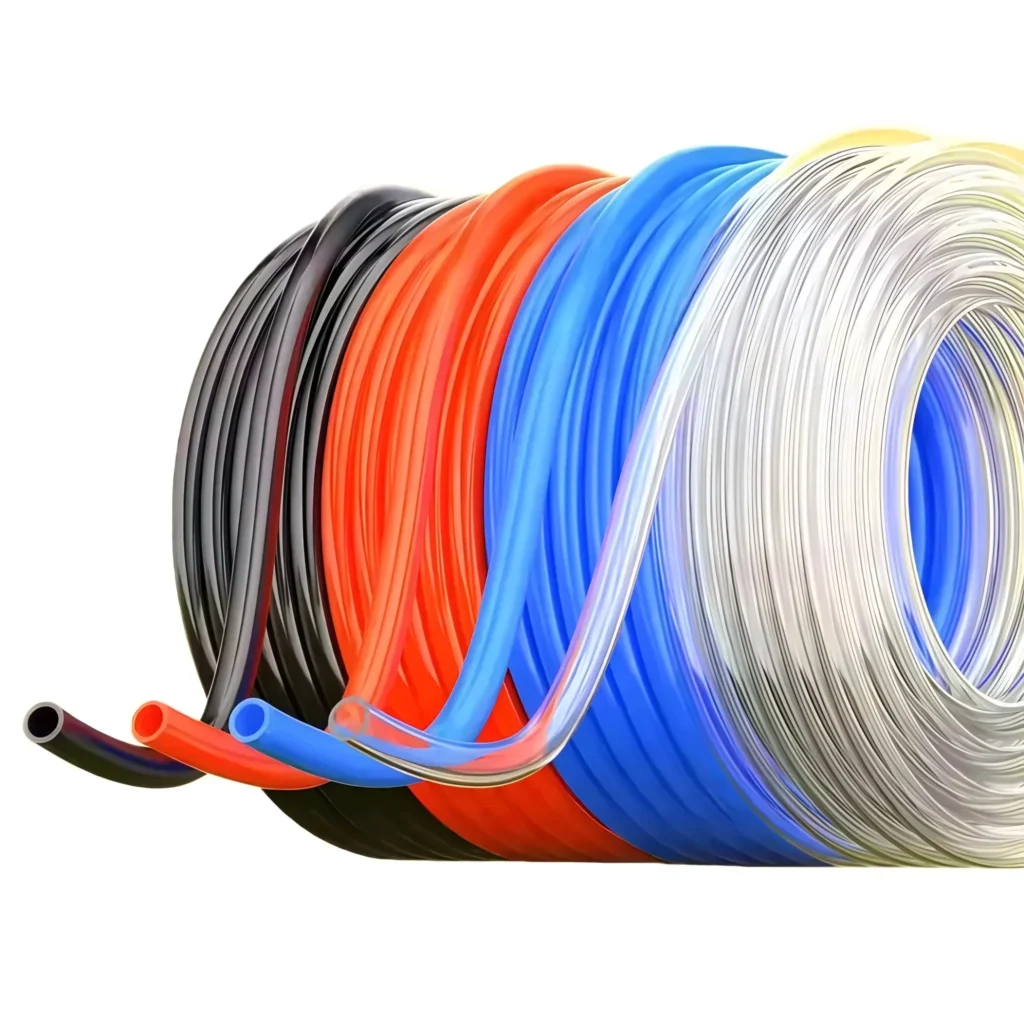
Polyurethane (PU) pneumatic tubing is a widely used pipeline type in pneumatic automation, which is extruded from thermoplastic polyurethane with Shore hardness Shore A 95-98. The material has high flexibility that can adapt to small radius bending, can be restored to its original state after bending, and can withstand repeated bending.
4 Pros:
- The flexibility and kink recovery are the best among the common polymers;
- The bend radius is as small as 3-5×OD, which is suitable for compact equipment.
- Good wear resistance of the bracket and the edge;
- Fast installation and low cost.
2 Cons:
- The upper limit of pressure is lower (standard is about 0.8 MPa);
- The ester-based grade will undergo hydrolysis, and the transparent or blue tubes may appear yellowing within 6-12 months under ultraviolet (UV).
What is Nylon (PA) Pneumatic Tubing?
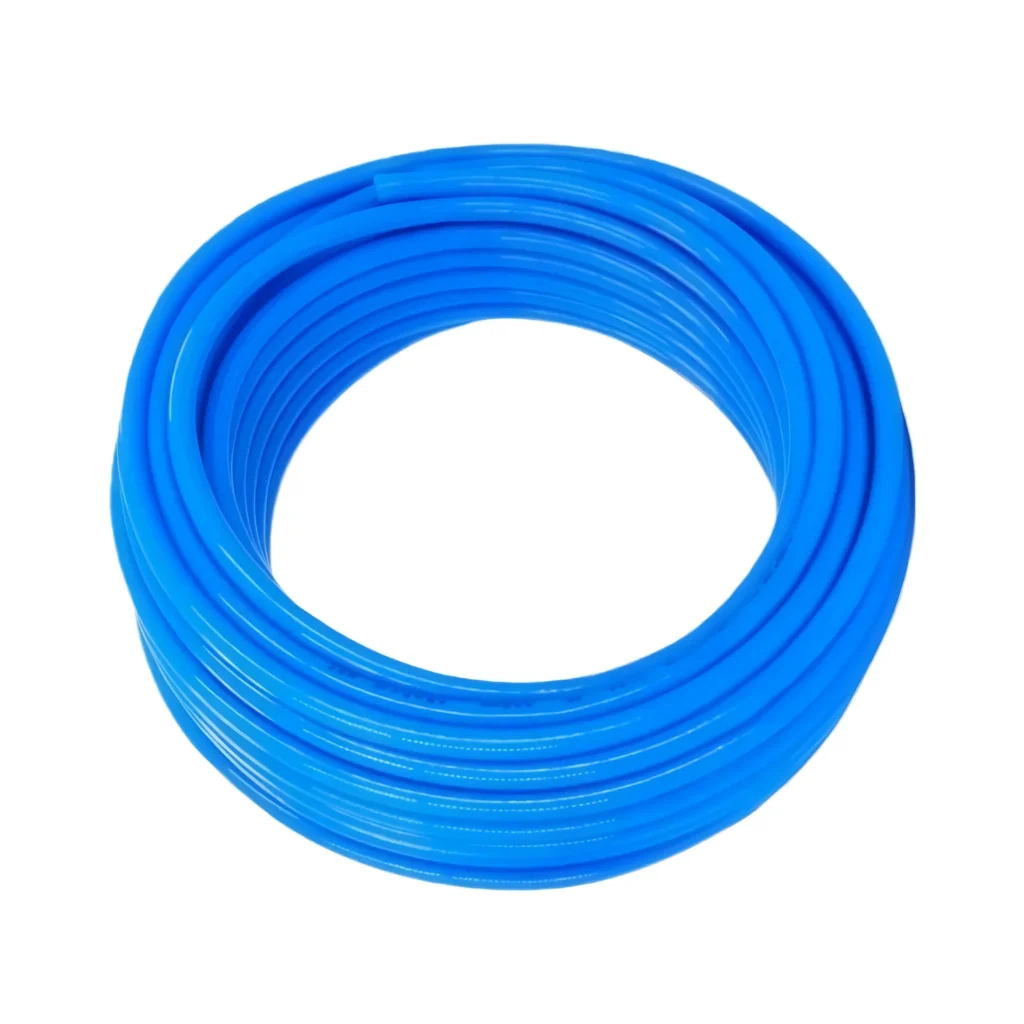
Nylon (polyamide/PA) pneumatic tubing is a kind of pneumatic hose with high rigidity and strength. PA12 and PA6 are semi-crystalline engineering plastics with high rigidity and dimensional stability.
4 Pros:
- Higher pressure and the upper limit of blasting
- Wider heat resistance range, up to + 100 ℃
- Better tolerance to oil, fuel oil and hydrocarbon
- The size is stable, which can make the push-in fitting seal force uniform.
2 Cons:
- Rigidity leads to a minimum bending radius of about 10×outer diameter (OD), which is easy to be discounted (kink) or stress-cracking in the narrow robot bending position.
- PA6 may expand in the fitting after moisture absorption.
PU vs Nylon Pneumatic Tubing Table
| Spec | PU Tubing (Polyurethane, 95–98 Shore A) | Nylon Tubing (PA12/PA6) |
|---|---|---|
| Working pressure @ ~20–23 ℃ | ~0.8 MPa/8 bar | 2.0–2.5 MPa/20-25 bar for PA12 6×4 mm at 4:1 SF; |
| Burst pressure @ 23 ℃ | ~3×working; | PA12 exceeds 6.0 MPa/60 bar; PA6 12 mm rated 1015 psi/7 MPa |
| Temperature range | −40 ℃ to +60 ℃, short-term +80 ℃ | −40 ℃ to +100 ℃ |
| Min. bend radius | 3–5×OD (dynamic); strong kink recovery | ~10×OD |
| Moisture absorption | Low; ester grades risk hydrolysis | PA12 <1.5%; PA6 hygroscopic |
| UV/outdoor | Clear/blue yellows in 6-12 months | PA12 UV-stable; good for outdoor lines |
| Best for | Robotics, moving axes, tight routing | High-pressure headers, heat, oil, fixed runs |
PU vs Nylon Pneumatic Tubing: Features Face to Face
The difference between PU and nylon pneumatic hose can be quickly understood through the above table.
Pressure ceiling
The 2.0-2.5 MPa working range of PA12 is two to three times that of the standard PU tube of 0.8 MPa, and its blasting margin of more than 6.0 MPa can provide guarantee for the pneumatic cylinder circuit.
Flexibility & kink recovery
PU can be coiled to 3-5×outer diameter (OD) and restored to its original state. Nylon needs about 10×outer diameter, which is easy to crack when forced bending. PU is the industry standard for drag chain applications.

Temperature range
Nylon can withstand up to + 100 ℃, while the upper limit of PU continuous use is +60 ℃. Therefore, PA is more suitable for heat sinks and pipelines near the engine.
Chemical & oil resistance
Polyamide can tolerate industrial oil, fuel oil and hydrocarbon, these media will make the softer PU tubing swell over time. Therefore, nylon is preferred in scenarios containing lubricants or machine gas.
Fitting retention under vibration
The hard wall of nylon can make the collet form a mechanical bite, while the softer PU relies on friction and is easier to pull out under vibration.
Routing speed, weight & cost
PU’s smaller winding radius, lighter roll weight and lower price per meter can shorten the installation time in the crowded panel;
Summary: The advantages of PU are flexibility, pipe laying speed and cost. The advantages of nylon are pressure, temperature range, chemical resistance and fitting holding. The final choice depends entirely on whether the pipeline needs to move.
Can PU pneumatic tubing be used at high pressure?
It is usually not preferred. The upper limit of working pressure of standard PU is about 0.8 MPa, even if the hard grade is less than 2.0-2.5 MPa of PA12. Nylon should be used when safety and service life under high pressure become key factors.
What is the difference between PA6 and PA12 nylon pneumatic tubing?
PA6 has higher hardness and lower price, but it is easy to absorb moisture, and the size will change after absorbing water. The moisture absorption rate of PA12 is less than about 1.5% and more stable, so PA12 is an industry standard in humid environments or high-precision pipelines.
Why does PU pneumatic tubing turn yellow and brittle?
The reason is that the ester-based PU undergoes hydrolysis, or the transparent/blue pipe is subjected to UV degradation, which may occur within 6-12 months. This problem can be avoided by using ether-based PU, anti-ultraviolet black PU, or PA12 instead.
What is the minimum bending radius of thePU and Nylon Pneumatic Tubing?
The minimum bending radius of PU can be roughly planned according to 3-5 × outer diameter (OD) and nylon can be planned according to 10 × outer diameter (OD). Forced bending nylon will appear stress-whitening and cracking; instead of excessive bending, it is better to use 90 ° elbow fitting.
Which Pneumatic Tubing Should You Buy?
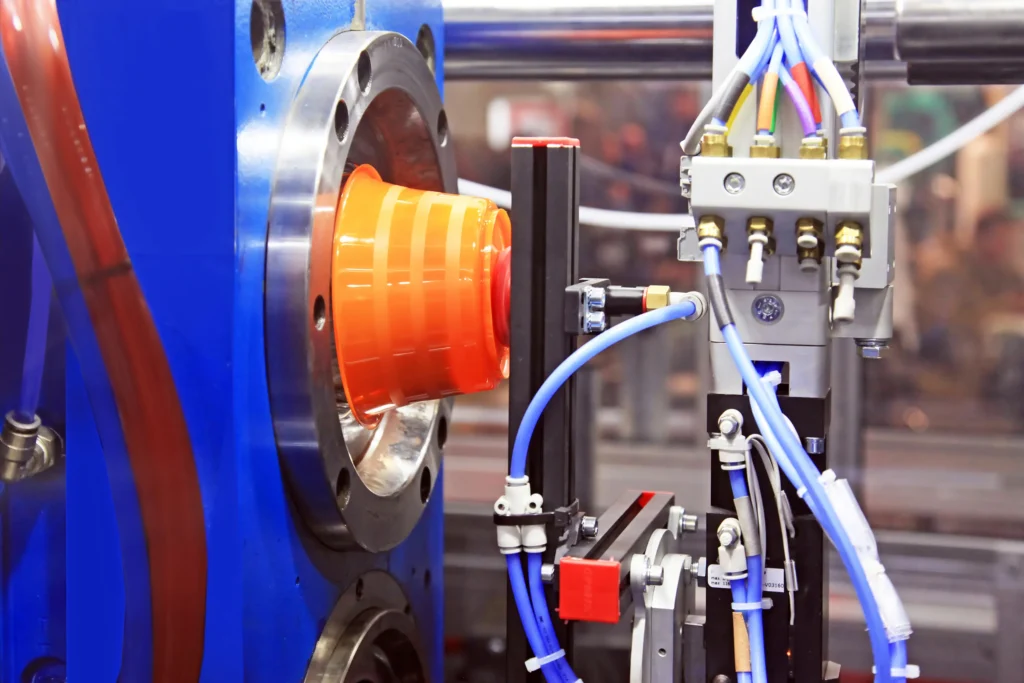
Use PU tubing if:
- The pipeline is reciprocating on the robot arm, gantry or drag chain;
- It is necessary to compactly arrange pipes with 3-5×OD in the crowded valve island;
- The working pressure is maintained at about 0.8 MPa and below the indoor panel.
Use nylon tubing if:
- Continuous pressure of more than about 1.0 MPa, such as the main pipe (header) used as a high thrust cylinder;
- The medium or ambient temperature is higher than 60 ℃, or the pipeline will come into contact with oil and fuel;
- The pipeline is fixedly laid and placed outdoors. At this time, the anti-ultraviolet stability and dimensional accuracy are more important than the bending radius.