Choosing NPT, BSPP or BSPT thread is crucial. Although the fitting may seem to match and can be spun into several laps, leakage will still occur under compressed air pressure. This article will explain the geometric structure, sealing method, size table checking method, and practical steps for identifying pneumatic fitting thread.
Product Introduction: 3 Kinds of Pneumatic Fitting Thread
You can basically understand the Fitting thread through the above video. Before selecting the ANRUK pneumatic fittings, you can use this section as an overview of the product differences between NPT vs BSPP vs BSPT thread. You can quickly understand through the following table:
| Item | NPT | BSPP | BSPT |
|---|---|---|---|
| Full name | National Pipe Taper | British Standard Pipe Parallel | British Standard Pipe Taper |
| Common marking | NPT, MNPT, FNPT | G, BSPP, PF | R, Rc, Rp, BSPT, PT |
| Thread shape | Tapered | Parallel/straight | Usually tapered male; matching female may be parallel or tapered |
| Thread angle | 60° | 55° Whitworth form | 55° Whitworth form |
| Seal location | Mainly on tapered thread interference | Outside the thread, usually O-ring, bonded washer, gasket, or seat | Mainly on tapered thread interference |
| Sealant | Usually PTFE tape or liquid sealant | Usually no thread sealant for the seal face | Usually PTFE tape or liquid sealant |
| Best-fit audience | North American pneumatic machines and replacement parts | European/Asian pneumatic manifolds where repeatable sealing and orientation matter | Imported equipment using ISO 7/R-series tapered pipe ports |
| Price impact | Low part cost, but mismatch causes rework | Slightly higher sealing washer/O-ring cost, easier service | Low part cost, but must match pitch and port type |
| Main risk | Over-tightening, cracked ports, sealant misuse | Missing or damaged washer/O-ring | Confused with NPT because both are tapered |
NPT thread: American cone pipe pneumatic fitting
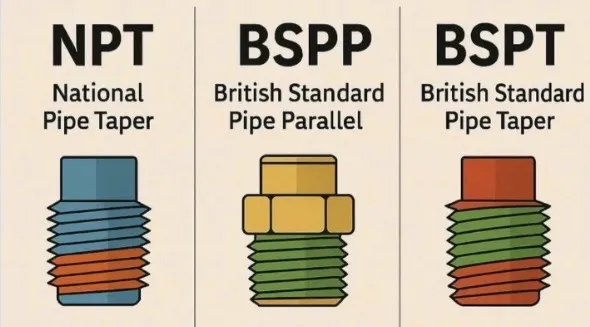
NPT is a tapered pipe screw thread, which is widely used in North American compressed air systems, pneumatic tools, valves, FRL units and pipe connectors. Its core feature is that the outer thread and the inner thread form a connection by gradually wedge tightening. Since the NPT adopts a 60°thread profile and the taper itself is part of the sealing design, a tight metal contact sealing path can be formed with the assistance of PTFE tape or liquid sealant.
If the equipment, manifold, FRL unit or pneumatic accessories are from the United States or Canada, purchasing NPT is usually more proper. Common aerodynamic specifications include 1/8,1/4,3/8 and 1/2 inch. It should be noted that the nominal size of NPT is not equal to the measured outer diameter. For example, the outer diameter of 1/4 NPT is not 0.250 inch ; it must be confirmed by measuring the outer diameter and TPI, and then comparing with the NPT thread dimensions table.
BSPP thread: parallel pipe thread for end face seals
BSPP is a British Standard Pipe Parallel thread, commonly marked as G. By comparing NPT, BSPP and BSPT thread, BSPP is the easiest to identify by appearance, because its outer diameter is basically consistent along the entire thread length. The role of the screw thread is mainly to fix the fitting position, and the pressure seal is usually completed by O-ring, bonded seal, gasket, cone seat or other external sealing surfaces.
This makes BSPP very suitable for pneumatic manifolds, compact push-in fittings, instrument interfaces, and equipment that requires repeated disassembly. It greatly features good maintainability: since the seal is not achieved by the extrusion cone thread, the interface is less likely to be damaged under the premise of correct installation. The risk is also clear: if the gasket is missing, even if the thread has been tightened, leakage can still occur at the fitting.
BSPT thread: inch cone pipe scheme for thread sealing
BSPT is a British Standard Pipe Taper thread. The outer cone thread is usually marked as R, and the matching internal thread marks include Rp (parallel internal thread that can be matched with R external thread) and Rc (conical internal thread). Since BSPT uses a 55°Whitworth thread profile, it is not equivalent to NPT even if the nominal size looks similar.
The advantage of BSPT lies in the equipment commonly found in the UK, Europe, China, Japan and many Asian pneumatic supply chains. Similar to NPT, BSPT usually requires a sealant because the pressure seal is mainly formed at the thread. BSPT is the correct thread series only when the interface is marked as R, Rc, Rp, PT or BSPT in actual applications. If the interface is marked as G/BSPP, it should not be assumed that the BSPT external thread can be used directly unless the equipment drawings explicitly allow it.
What is the Difference between NPT, BSPP and BSPT Thread?
After basically understanding the NPT, BSPP and BSPT thread, the following aspects are compared one by one from the aspects of geometric structure, sealing method and size measurement.
Thread geometry: tapered or parallel
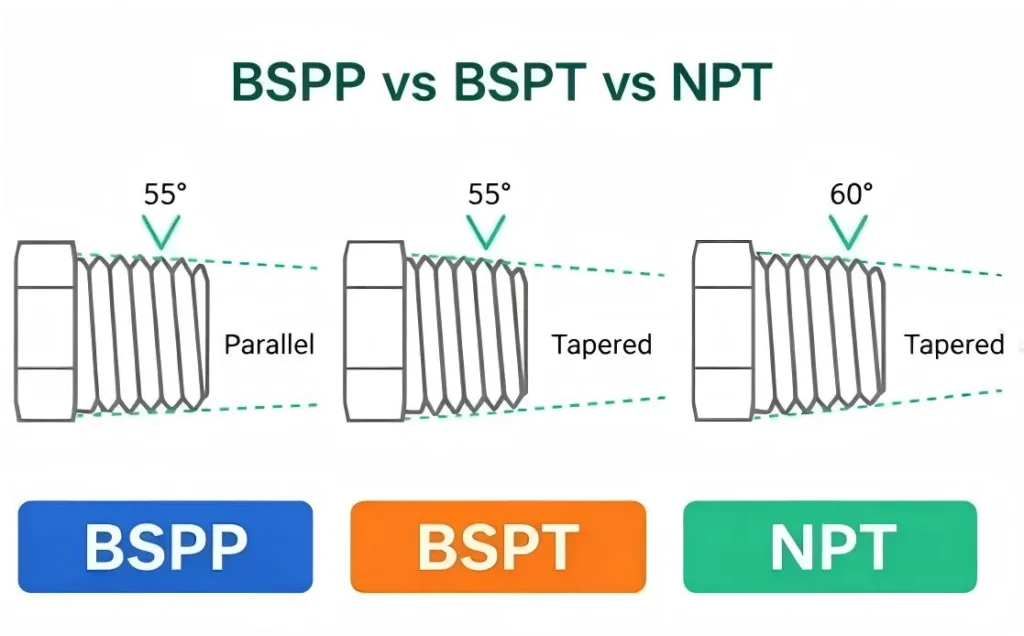
The first step to identify NPT, BSPP and BSPT threads is to check the geometry. Since the geometric structure directly determines the sealing method, it should first determine whether there is a taper. The caliper can be used to measure the diameter of the outer thread near the first round of the complete thread and near the end. If the diameter changes, the fitting is likely to be a tapered thread, i.e. NPT or BSPT. If the diameter is basically consistent, it is more likely to be BSPP.
However, taper alone is not enough to completely judge, because both NPT and BSPT are conical threads. The second feature was thread profile angle: NPT used 60°profile, while BSPP and BSPT used 55°Whitworth profile. The third feature is pitch. For example, 1/4 NPT is 18 TPI and 1/4 BSP is 19 TPI. One tooth per inch is enough to cause poor occlusion and air leaks.
Sealing method: thread seal or end face seal
If the thread itself is required to perform the sealing function, the fitting is usually NPT or BSPT. The sealant can help fill the spiral leakage path and improve the pressure holding capacity. However, more sealant is not necessarily better. Excessive PTFE tape may lead to cracking of the small pneumatic interface, contamination of the valve body, or misjudgement of tightening.
If the fitting is sealed by gasket, O-ring, combined gasket or plane sealing end face, it is usually BSPP. This is also the reason why BSPP is often used in scenarios requiring directional control, such as elbow fittings, swivel fittings, and push-to-connect pneumatic fittings. The installer can complete the sealing by pressing the tight sealing surface without forcibly twisting one more cone thread in the alignment direction.
Measurement method: use the outer diameter, TPI and the correct size table
The fastest field identification method is divided into three steps: First, use a caliper to measure the outer diameter of the external thread. Secondly, the TPI was confirmed by a thread pitch gauge. Finally, the measured outer diameter and TPI were compared with the corresponding NPT thread dimensions or BSPT thread chart. Do not rely solely on the nominal size to determine the type of thread.
| Nominal size | Typical NPT check | Typical BSPP/BSPT check |
|---|---|---|
| 1/8 | 27 TPI, about 0.405 in OD | 28 TPI, about 9.728 mm major diameter |
| 1/4 | 18 TPI, about 0.540 in OD | 19 TPI, about 13.157 mm major diameter |
| 3/8 | 18 TPI, about 0.675 in OD | 19 TPI, about 16.662 mm major diameter |
| 1/2 | 14 TPI, about 0.840 in OD | 14 TPI, about 20.955 mm major diameter |
The above table shows the reasons why NPT, BSPP and BSPT threads are often misjudged. Part of the size is very close, can be manually screwed into a few laps, but far from the degree of fit required for the correct sealing. If the maintenance personnel only replace the fitting according to the size of “1/4 inch”, there will often be a slow leakage after pressurization.
Compatibility: similar appearance does not mean that it can be safely assembled
NPT and BSPT should not be mixed. Both are different in tooth angle, thread shape and pitch of most specifications. The NPT external thread may be able to screw into the BSPT or BSPP interface for several turns, but the thread side cannot be correctly fitted. Under pressure, this mismatch may lead to air leakage, interface damage or subsequent disassembly difficulties.
It’s crucial to carefully distinguish between BSPP and BSPT. The BSPT R external thread is designed for matching Rp or Rc internal thread combinations and follows ISO 7 thread sealing standards. The G/BSPP interface belongs to the ISO 228 parallel fixed thread, and the pressure seal is not completed by the thread itself. If the drawing is marked as G1/4, the correct G thread fitting should be selected and matched with a suitable washer or O-ring.
Installation feel: tightening process can reflect the type of thread
The BSPP connector is usually tightened to the step, gasket or O-ring end face during proper installation. NPT or BSPT fittings are gradually wedged into the interface due to taper, and the tightening resistance will gradually increase. If the taper thread fitting is suddenly stuck after only one or two turns, the operation should be stopped immediately and the thread standard should be re-confirmed. If the parallel thread fitting has been screwed to the bottom but has not pressed any seal, it should be checked whether the washer is missing or whether the interface design matches.
ANRUK pneumatic fitting selection rules: the equipment interface standard must be confirmed before selecting the fitting. The pipe diameter specifications such as 6 mm, 8 mm or 10 mm only indicate the pipe size suitable for the quick-inserting end, and do not specify the type of threaded end. Whether the thread end is NPT, G (BSPP), or R (BSPT) still needs to be confirmed separately.
Which Pneumatic Fitting Thread Should be Selected?
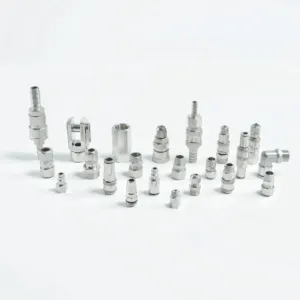
The final choice of NPT, BSPP or BSPT thread should be based on the interface drawings, rather than on the appearance of speculation.
If the equipment comes from North America, the interface is marked as NPT/NPTF, or the maintenance team has an NPT pneumatic adapter for a long time, NPT should be selected. If the interface is marked as G, the fitting relies on a gasket or O-ring seal, or requires repeated disassembly and elbow direction control, BSPP should be selected. If the interface is marked as R, Rc, Rp, PT or BSPT, especially for imported pneumatic equipment, BSPT should be selected. The most reliable way to do this is not to use a thread that looks like it can be screwed in, but rather a thread that is confirmed by taper, TPI, outer diameter, sealing method, and equipment drawings. If you still have any questions about pneumatic fittings, contact the ANRUK team.
FAQ
What is BSPT thread?
BSPT thread is British Standard Pipe Taper thread, which is used to form a pressure seal connection by matching threads. The 55°Whitworth profile is usually used, and the outer taper thread is often marked as R. In pneumatic fittings, BSPT should be selected only when the interface or drawing clearly marks BSPT, R, Rc, Rp or PT.
What is an NPT thread?
NPT thread (National Pipe Taper thread) is commonly used in pneumatic tools, air compressors, valves and pipe fittings. NPT uses a 60°thread profile, usually relying on tapered thread interference fit, supplemented by PTFE tape or liquid sealant to achieve sealing. NPT should not be regarded as interchangeable with BSPT.
What is a BSPP thread?
BSPP thread is British Standard Pipe Parallel thread, often marked as G. It is a straight thread, and the outer diameter is basically consistent along the thread length. BSPP usually does not rely on the thread itself to seal, but through the O-ring, combined washer, gasket, cone seat or other end face seal structure to withstand pressure.
How to measure NPT thread size?
When measuring the NPT thread size, the outer diameter of the external thread should be measured with a caliper first, then the TPI should be confirmed with a pitch gauge, and finally the NPT thread dimensions table should be compared. Not only look at the nominal fractional size. For example, the outer diameter of 1/4 NPT is not 1/4 inch, so it must be confirmed by both outer diameter and TPI.
What is the function of a BSPT thread chart?
BSPT thread chart is used to correspond the nominal thread size to TPI, large diameter, small diameter and tapping hole data. It is helpful to confirm whether the fitting specifications are 1/8, 1/4, 3/8, 1/2 or other BSP sizes. Since BSPT and BSPP share similar dimensions and pitch references on many specifications, the size table is particularly critical.