There is only one decisive parameter for choosing direct acting or pilot-operated solenoid valve: the minimum differential pressure of the system. Pilot-operated solenoid valves have higher energy efficiency in most industrial pipelines with pressure and large flow. Direct-acting solenoid valves are more suitable for zero pressure, vacuum or fast switching conditions. The following will detail the specific specifications, selection considerations and decision rules to assist you in accurate selection.
Comparison Table: Direct-Acting vs Pilot-Operated Solenoid Valve
| Decision Factor | Direct-Acting Solenoid Valve | Pilot-Operated Solenoid Valve |
|---|---|---|
| Minimum pressure differential (ΔP) | 0 bar:opens at zero ΔP, vacuum, and gravity-fed lines | ~0.3–0.5 bar required before the diaphragm lifts |
| Typical orifice size | Small, ~0.5–6 mm (bore usually ≤25 mm) | Large, ~10–50 mm or more |
| Response time | Very fast, often under 20 ms | Slower, ~50–500 ms (pilot chamber must vent first) |
| Power per unit of flow | Higher (coil lifts the seat directly; ~5–20 W) | Lower:one small coil controls a large orifice |
| Maintenance/dirty media | Tolerant; no tiny pilot orifice to clog | Pilot orifice needs a 40–100 µm upstream strainer |
| Max pressure scaling | Limited; very high pressure needs bigger coils | Scales well to high pressure with a compact coil |
| Relative unit price | Lower in small sizes | More cost-effective per unit of flow at large sizes |
| Best for (who wins) | Engineers running vacuum, low-pressure, dosing, or fast-cycling lines | Engineers running high-flow, pressurized, continuous-duty lines |
Note: the value is a typical interval of the industry, please refer to the specific model datasheet.
What is Direct-Acting and Pilot-Operated Solenoid Valve?
Through the above table, we can quickly and easily understand the differences between direct-acting and pilot-operated solenoid valves. The following will introduce their own details.
Direct-acting solenoid valve: suitable for zero pressure differential conditions

ANRUK’s compact 2V series and 3V series adopt direct-acting design and are specially developed for small-diameter and low-voltage control. The core feature of the direct-acting solenoid valve is that the coil directly drives the spool: because the seal itself is part of the moving core, the valve can be opened and closed only by electromagnetic force, without relying on pipeline pressure. Therefore, its main feature is: 0 bar can work.
Advantages:
- It can be normally opened in zero differential pressure, vacuum and gravity-fed systems.
- Fast response, usually less than 20 ms, suitable for high-frequency on-off operation.
- The number of moving parts is the least among all solenoid valves, and the durability is higher.
- It has strong adaptability to the medium containing impurities, because there is no small pilot orifice to plug.
Disadvantages
- The power consumption is high, and the coil must directly overcome the medium pressure and spring force.
- The orifice and flow rate are limited, and the bore is usually about 25 mm.
Pilot-operated solenoid valve: main choice for large flow conditions
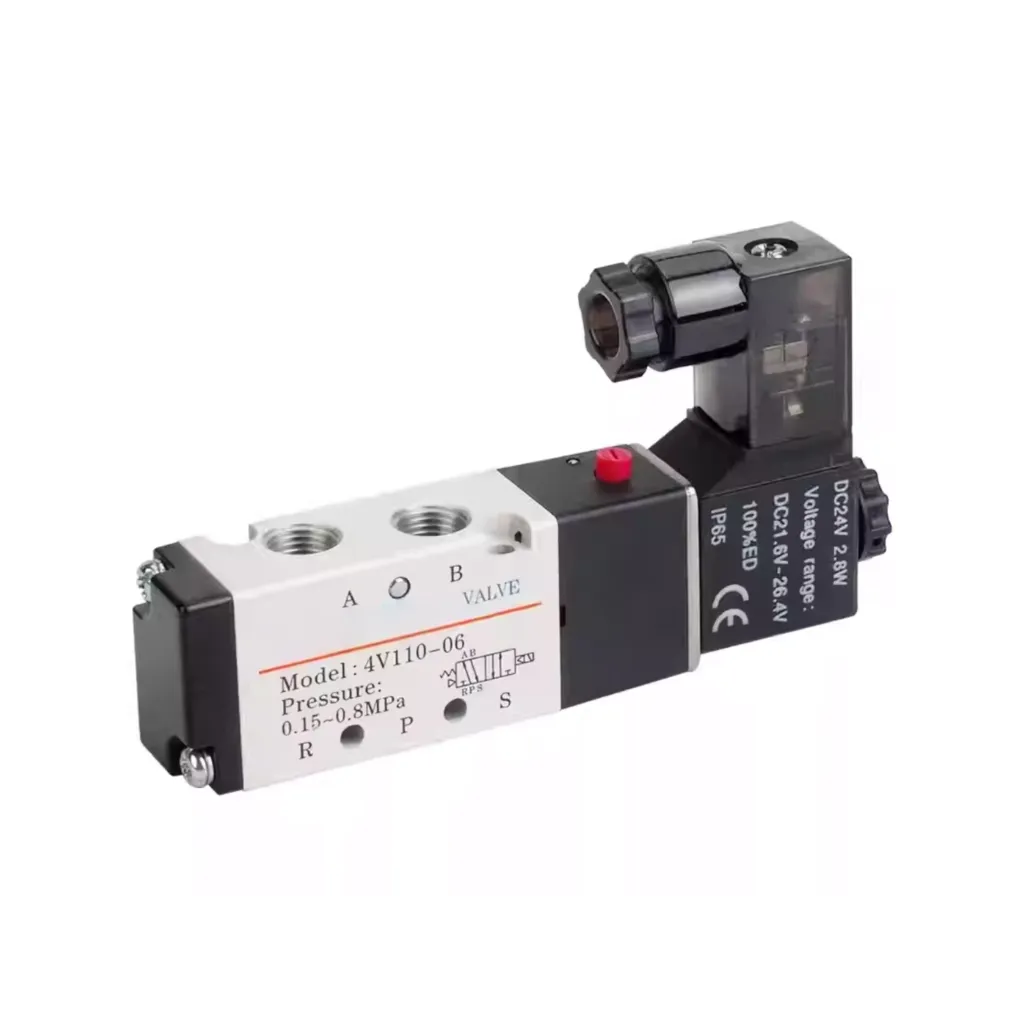
ANRUK’s 4V series and pilot-operated 4/5-port solenoid valves cover servo-assisted (internal pilot). When working, the coil only opens a small pilot orifice. Then, the diaphragm or piston is pushed by the pipeline pressure of the system itself, and the larger main orifice is drilled. The outstanding feature: the use of small coils can control large flow, and the power consumption is very low.
Advantages:
- A small coil can control a large valve hole of about 10-50 mm and a high flow.
- Compared with the flow rate, the power consumption is low, which is suitable for continuous duty.
- Driven by pipeline pressure, it can withstand higher operating pressure.
- The coil is less heated and energized for a long time and is not easy to burn.
Disadvantages:
- The minimum differential pressure (about 0.3-0.5 bar) is required and cannot be turned on at zero differential pressure.
- The response speed is slow, and the pilot hole is easy to be blocked, so the upstream filter must be configured.
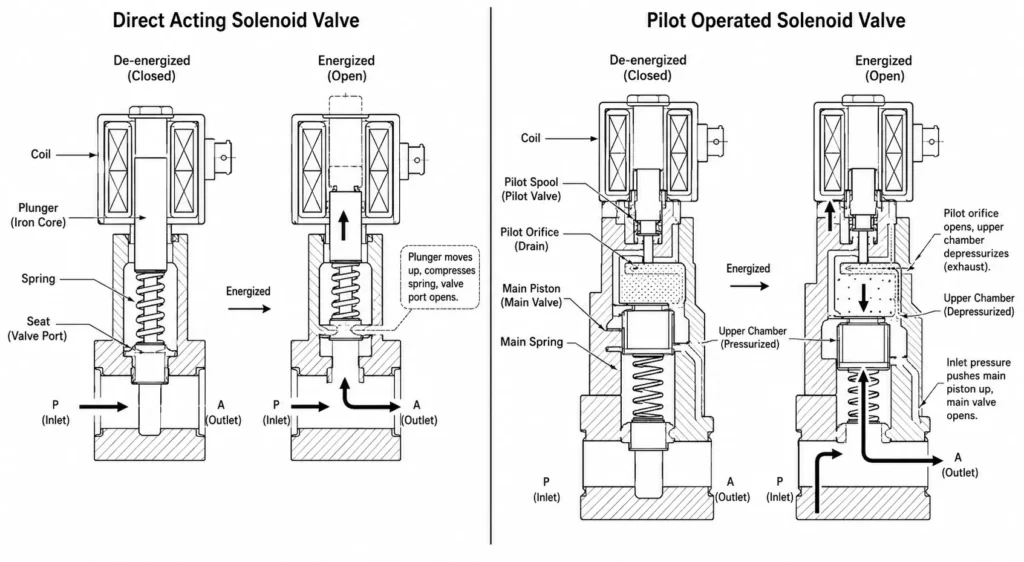
Comparison of Common Characteristics between Direct-Acting and Pilot-Operated Solenoid Valve
Zero-pressure capability: direct-acting type has better performance. Only the direct-acting solenoid valve can be opened without pressure difference, which is the only applicable type of vacuum, gravity feeding and low-level liquid pipeline.
Flow & orifice: the pilot-operated solenoid valve is dominant. With the help of pipeline pressure to push the diaphragm, the pilot-operated solenoid valve can open a large valve hole that far exceeds the direct drive capability of the same coil, thereby obtaining a higher flow coefficient Cv.
Response time: direct-acting solenoid valve is faster. The valve seat is opened directly, and the switching time is usually within 20 ms. The pilot-operated solenoid valve needs 50-500 ms to wait for the pilot chamber to complete the charging and discharging.
Power efficiency at a given flow rate: energy efficiency of pilot-operated solenoid valves is higher. The large valve hole is controlled by a small coil, and the power consumption per unit flow is lower, which is particularly critical for circuits that require long-term continuous energization.
Contamination tolerance: anti-fouling performance of direct-acting solenoid valves is stronger. There is no small pilot hole inside, which is more reliable for the passage of media containing impurities or high viscosity. The pilot-operated solenoid valve must be equipped with a 40-100μm filter to keep smooth.
High-pressure scaling: pilot-operated solenoid valve has more advantages in the field of high pressure. When the pressure is about 30 bar or more, the coil size required to directly open the valve seat is too large and loses practicality. At this time, it is replaced by the piston pilot design.
Features of Direct-Acting and Pilot-Operated Solenoid Valve
Zero-differential operation: the valve core is directly driven by the coil instead of relying on the fluid pressure, so the valve can still open normally even if the inlet and outlet pressures are equal. This is the decisive advantage of the vacuum system and the tank discharge pipeline, and the pilot cannot work under this condition.
Minimal moving parts: moving iron core, spring and valve seat almost constitute the whole structure, and the possibility of wear, fouling and dislocation is lower. This has durability advantages in quantitative filling and high-frequency action equipment.
High Cv per Watt: servo-assisted stage enables low-power coils to control large flow rates. On large-diameter water pipelines or compressed air main pipelines, the pilot-operated design can provide flow that cannot be achieved by direct-acting under the same coil specifications.
Large-orifice scalability: the main seal relies on the pipeline pressure, and the size of the valve body and the valve hole can be increased without increasing the coil. This is the reason why the large flow confluence plate usually adopts the pilot-operated type.
FAQ
Which responds faster for direct-acting and pilot-operated solenoid valves?
The response of a direct-acting solenoid valve is faster. It directly opens the valve seat, switching time is usually within 20 milliseconds; the cavity of the pilot-operated solenoid valve needs to complete the filling and pressure relief first, which takes about 50-500 ms. The direct-acting solenoid valve is more reliable under the condition of fast quantitative or high frequency pulse.
Which type of solenoid valve uses more power?
At a given flow rate, the direct-acting solenoid valve usually consumes more power because its coil must overcome all pressure and spring force to open the valve seat. The pilot-operated solenoid valve controls the large valve hole through a small coil. In the large flow and continuous energized pipeline, the flow per unit power is much higher than that of the direct-acting solenoid valve.
Which of the direct-acting and pilot-operated solenoid valves is more suitable for dirty media?
Tolerance of direct-acting solenoid valves is better. There is no small pilot hole in it to plug, and it is more reliable when particles or high viscosity fluid pass through. If the pilot type must be selected due to flow requirements, 40-100μm upstream filters should be added to prevent pilot hole blockage.
How to determine whether my solenoid valve is direct-acting or pilot-operated?
Check the minimum operating pressure of the data table. If it is marked as 0 bar (or zero differential), it is a direct type; if the minimum value of 0.3-0.5 bar is marked, it is a pilot-operated solenoid valve. From the appearance point of view, there is a diaphragm or piston above the main valve seat of the pilot-operated solenoid valve, and the orifice of the direct valve is sealed directly by the plunger.
Does the pilot-operated solenoid valve have to have a minimum pressure to open?
Yes. The pilot-operated solenoid valve relies on differential pressure (usually 0.3-0.5 bar) to push the diaphragm. When the pressure difference is lower than the threshold, the main valve hole may not open even if the coil is fully energized. This is one of the most common errors in the selection of low voltage systems.
How to Choose between Direct-Acting and Pilot-Operated Solenoid Valve?
Select the direct-acting solenoid valve: your pipeline is at or near zero pressure (vacuum or gravity feed); a response within 20 ms is required to achieve fast high-frequency on-off; or need to transport the dirty, high viscosity medium that will block the pilot hole.
Select the pilot-operated solenoid valve: you want to control the high flow rate on the large valve hole of the pressurized main pipe; the system can stably maintain at least 0.3-0.5 bar differential pressure. Or the valve is energized for a long time, with low power consumption and low coil temperature as the priority.
Need to match the solenoid valve type according to your pressure and flow conditions? Please visit ANRUK’s solenoid valve series, or refer to our solenoid valve symbol guide to learn the identification diagram.