Choosing ISO 15552, ISO 21287 or ISO 6432 pneumatic cylinders mainly depends on 3 conditions: bore (piston inner diameter), output force under lateral load, and available installation space. For most general automation scenarios, the standard ISO 15552 is usually a more suitable choice due to its structural rigidity and more accessories. The following will introduce precise cylinder diameter range, buffer method, and cost consideration that determine the selection of specific projects.
Meet the Three Pneumatic Cylinder Standards
| Spec | ISO 15552 (Standard/Profile) | ISO 21287 (Compact) | ISO 6432 (Mini/Round) |
|---|---|---|---|
| Standard bore range | 32–320 mm | 20–100 mm | 8–25 mm |
| Body shape | Square aluminium profile/tie-rod | Short profile block | Round, crimped stainless tube |
| Overall length vs ISO 15552 | Baseline | ~40–50% shorter | — (small bores only) |
| Side-load tolerance | Highest | Low | Low–moderate |
| Cushioning | Adjustable pneumatic | Fixed elastic | Fixed elastic |
| Sensor mounting | Integrated T-slots | T-slots | Magnet option/band |
| Max working pressure | 10 bar (1000 kPa) | 10 bar (1000 kPa) | 10 bar (1000 kPa) |
| Best for | Heavy-duty, side loads, long stroke | Tight footprint, clamping | Light, precise, small spaces |
| Indicative cost | $$ | $$ | $ |
| ANRUK series | SC, DNC, DSBC | CQ2, ADN, SDA | MA, MAL, C85 |
The cost is a relative value ($ = minimum) and varies with cylinder diameter, material and brand. ISO 15552 has replaced the repealed ISO 6431/VDMA 24562.
These three standards are all developed by ISO TC131/SC3 based on the 1000 kPa (10 bar) working pressure series, so they have the same upper pressure limit, but differ in size, shape and bearing capacity.
ISO 15552: Standard profile pneumatic cylinder
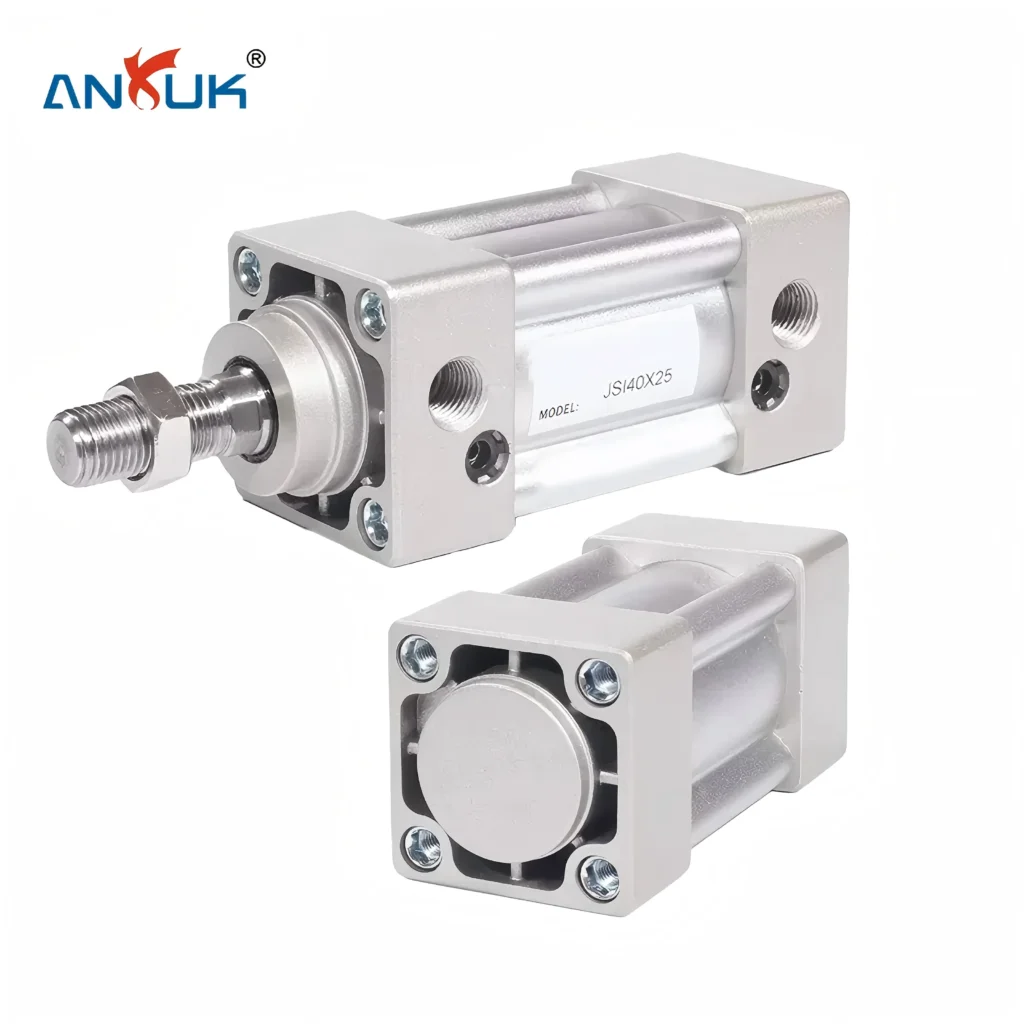
Due to the widest bore coverage, the ISO 15552 standard pneumatic cylinder is the main model in industrial pneumatics. ISO defines it as “cylinders with detachable mountings, cylinder diameter 32-320 mm” (cylinders with detachable mountings), using a square aluminum profile or an old tie-rod cylinder block; the nose bearing has the highest rigidity among the three because of the long distance between the nose bearing and the piston.
Pros:
- Widest cylinder diameter range (32-320 mm)
- Highest lateral load bearing capacity
- Both ends can be equipped with adjustable pneumatic cushioning.
- The most complete range of detachable mounting parts and accessories (foot frame, flange flange, intermediate trunnion, fork joint clevis).
Cons:
- The overall shape is the longest under the same stroke.
- It is heavier than compact or micro cylinders.
ISO 21287: Compact pneumatic cylinder
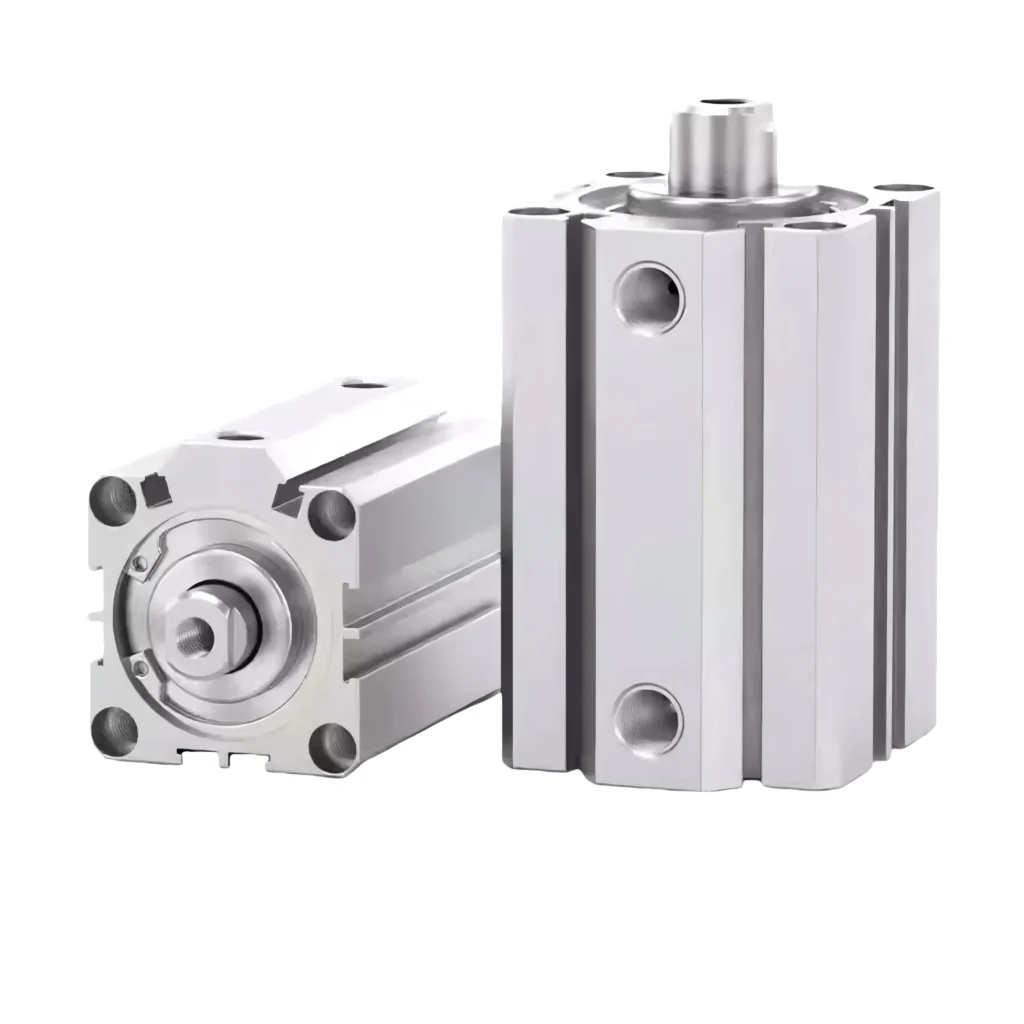
The ISO 21287 compact pneumatic cylinder is designed for such requirements when the mounting length is limited but still requires a real output force. ISO defines it as a “compact cylinder with a cylinder diameter of 20-100 mm”. This cylinder provides an output force equivalent to the standard cylinder diameter in a significantly shorter cylinder by shortening the distance between the piston and the front cover.
Pros:
- Under the same cylinder diameter and stroke, the length is shortened by about 40-50 % compared with ISO 15552.
- The output force of the same cylinder diameter is equivalent.
- Piston rod-end accessories can be shared with ISO 15552, and end-cover mounting holes can be shared when the cylinder diameter is 32-100 mm.
- Equipped with a T-groove sensor
Cons:
- The built-in elastic cushioning is not adjustable;
- The lateral load bearing capacity is low, so it is not suitable to bear the lateral load.
ISO 6432: Mini/round pneumatic cylinder
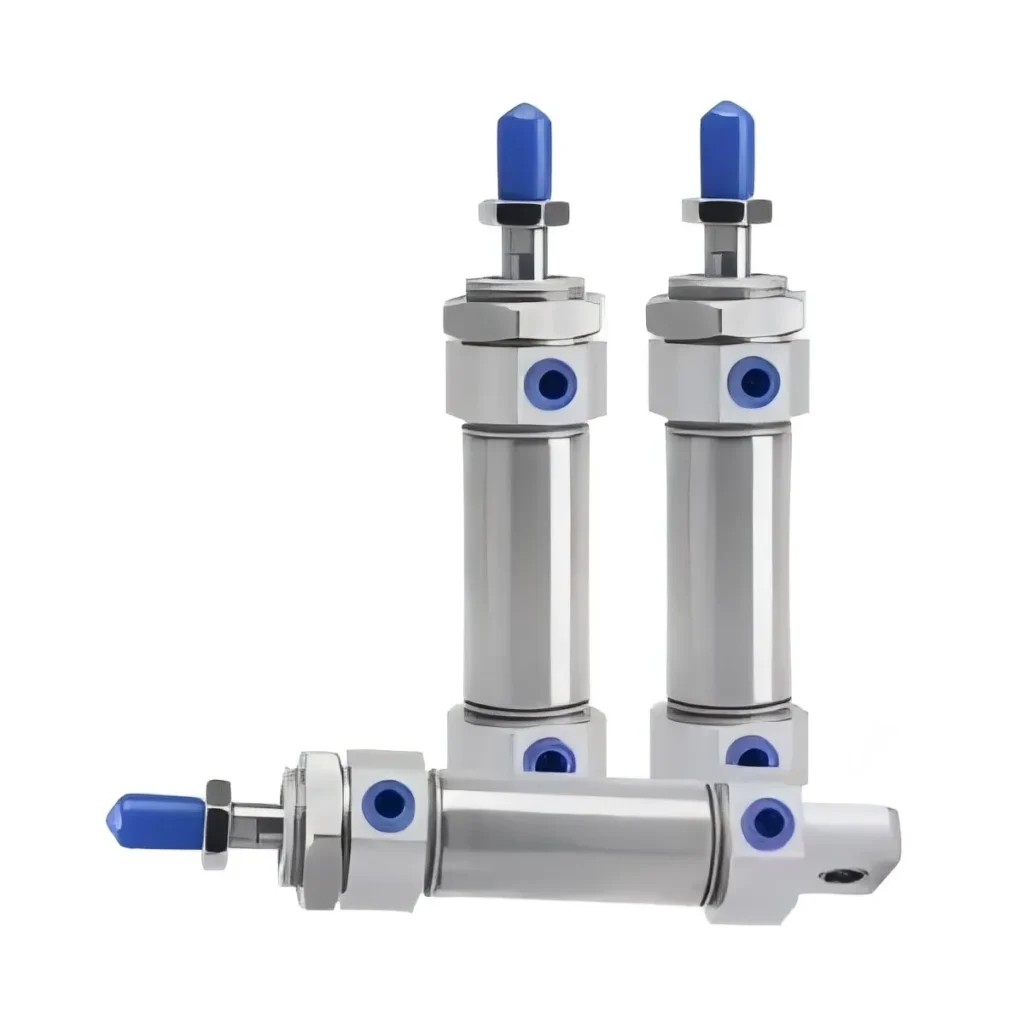
The ISO 6432 mini/round pneumatic cylinder is superior when the installation space is small and requires small precision movements. ISO defines it as a “single-rod cylinders, cylinder diameter 8-25 mm”, using a slender circular stainless steel cylinder with a threaded nose & tail, which can be installed directly through the plate.
Pros:
- The smallest size (cylinder diameter 8-25 mm)
- It can be installed directly through the nose thread (panel mounting).
- Light weight, suitable for mass assembly
- An optional magnetic piston is available for position detection.
Cons:
- According to the standard, only mechanical/elastic buffer (non-air-adjustable buffer).
- Under small cylinder diameter, the output force and lateral load bearing force are limited.
Features Face to Face: ISO 15552 vs ISO 21287 vs ISO 6432 Standards Pneumatic Cylinder
Comparing the three pneumatic cylinder standards item by item in common characteristics can make the selection process more specific. Each of the following comparisons gives more advantageous criteria.
The cylinder diameter range and the upper limit of the output force (bore & force) – ISO 15552: ISO 15552 covers 32-320 mm, which can achieve the output force that the other two standards cannot provide.
The compact footprint – ISO 21287: ISO 21287 shortens the total length by 40-50 % under the same cylinder diameter and can be installed where the standard cylinder cannot accommodate.
Minimum mounting size – ISO 6432: with an 8-25 mm round cylinder block and threaded nose, ISO 6432 can fit into a narrow space that neither of the two larger standards can fit.
Side-load – ISO 15552: the front cover guide bearing of ISO 15552 has a longer distance from the piston, so it is more resistant to lateral forces; compact and micro cylinders should not bear such loads.
Cushioning controllability (cued) – ISO 15552: only ISO 15552 standard with adjustable gas buffer; both ISO 21287 and ISO 6432 use fixed elastic cushions.
Accessory interchange – ISO 15552/ISO 21287: ISO 21287 and ISO 15552 share the piston rod end attachment and can also share the end cap mounting hole in the range of cylinder diameter 32-100 mm, so it can be selected from the same attachment.
Small bore cost – ISO 6432: for light load tasks below 25 mm, the ISO 6432 micro cylinder is the lowest cost solution for motion.
Note: ISO 15552 pneumatic cylinder performs better in most feature comparisons, so it is still the default choice for new designs. However, once space becomes the dominant constraint, the advantages of ISO 21287 and ISO 6432 pneumatic cylinders are immediately apparent.
FAQ
Can I replace the old ISO 6431 pneumatic cylinder with an ISO 15552 cylinder?
Yes. ISO 15552 is the modern successor standard of the abolished ISO 6431 (and VDMA 24562), and the mounting-hole centers remain unchanged. The cylinder block has been changed from the exposed pull rod to the profile cylinder, so it is recommended to use the T-groove sensor instead of the old pull rod sensor bracket.
Which standard pneumatic cylinder has the largest output force?
Under the condition of the same cylinder diameter and 10 bar, the theoretical output force of the three is the same, because the output force depends on the cylinder diameter and pressure. ISO 15552 can achieve greater actual output because it provides a much larger cylinder diameter (up to 320 mm) and can withstand the lateral loads associated with heavy loads.
Can the ISO 21287 compact pneumatic cylinder withstand lateral loads?
Usually not. In order to shorten the length, the design of the piston and the end cover is short, resulting in reduced rigidity, and the lateral force may cause the piston rod to jam or accelerate wear. If the application requires both a compact shape and a lateral load, the guide cylinder or slide cylinder designed for this purpose should be used instead.
Is the standard working pressure of the three pneumatic cylinders the same?
Same. ISO 15552, ISO 21287 and ISO 6432 were formulated according to the 1000 kPa (10 bar) series, and the maximum working pressure was the same. The differences between them are in size, cylinder shape, buffer mode and bearing capacity, rather than pressure level.
Is the buffer of ISO 6432 pneumatic cylinders adjustable?
Unadjustable. The ISO 6432 standard specifies fixed mechanical or elastic cushioning, excluding adjustable air cushioning. Some manufacturers may provide adjustable or adaptive buffers as non-standard options, so if you need controllable travel end deceleration, please refer to the specific product data sheet.
Which Pneumatic Cylinder Standard to Use?

ISO 15552 is used in the following cases: the piston rod is subjected to lateral load (such as swing door or conveyor line pushing); need more than 100 mm cylinder diameter or long stroke; or you may want to have adjustable air cushioning with the widest range of installation options.
Use ISO 21287 in the following cases: limited axial space of existing equipment; retrofit and hope to continue to use ISO 15552; or short stroke clamping and pressing applications need to obtain the output force of the standard cylinder diameter within about half of the cylinder length.
ISO 6432 is used in the following cases: cylinder diameter is 25 mm and below; the nose thread is directly installed through the plate; or mass assembly requires a large number of lightweight, low-cost actuators. In any size, if you need to bear the lateral load, please use the guided cylinder.
Browse ANRUK’s range of pneumatic cylinders covering all three ISO standards; or offering an older model, contact our engineering team to obtain an equivalent product that can be replaced directly.